)
)
Microelectronics UK 2026 Startup Spotlight: Ohm Lab
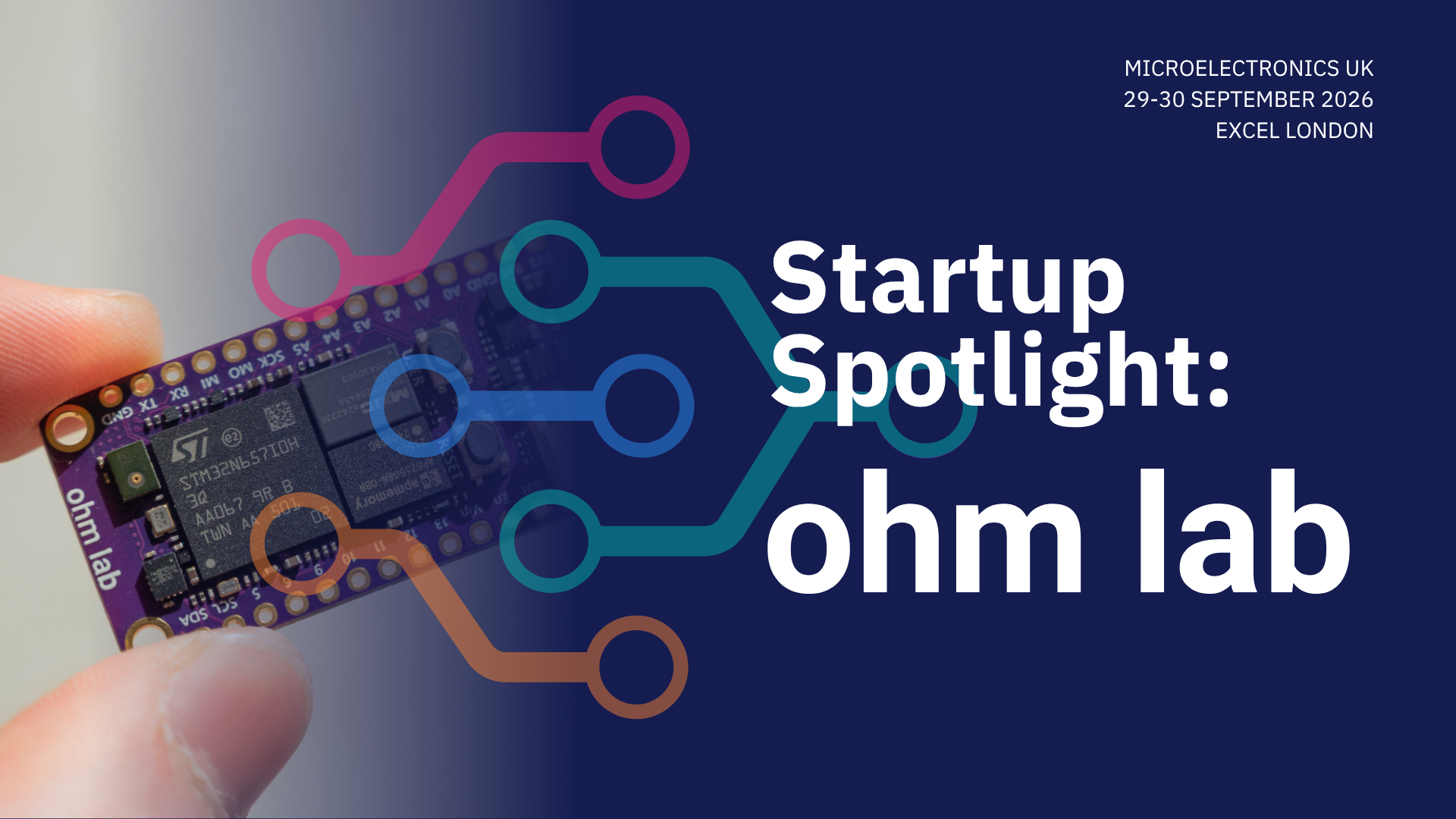
As part of a new series, Microelectronics UK is featuring a series of interesting and innovative startups and inviting them to tell their stories. Kicking things off is Ohm Lab, a Hampshire-based company which builds hardware and software helping engineers deploy AI vision cheaper and faster on compact, low power hardware. The two founders are Mukund Srinivasa Raghavan and Hamish Morely.
You can find out more about Ohm Lab here. Many thanks to Mukund Srinivasa Raghavan for providing these answers.
How did the business come about?
Hamish and I have known each other since secondary school, and we have always shared an interest in engineering and entrepreneurship. Ohm Lab began when Hamish identified an opportunity in edge AI: vision models were becoming increasingly capable, but deploying them on compact, low power hardware was still unnecessarily difficult. The models existed, and the silicon was improving, but the path from dataset to working embedded product remained fragmented. When STMicroelectronics announced the STM32N6, with dedicated on chip AI acceleration, we saw an opportunity to bring this new class of microcontroller into the Arduino IDE and make edge AI development accessible to a much wider market.
What industry problem are you solving?
Many teams can demonstrate AI vision on a laptop, Raspberry Pi or larger embedded computer, but struggle to turn that into a small, efficient product. Linux based platforms are often too large, power hungry or costly for volume products, while traditional microcontrollers have not had enough compute for meaningful vision AI. New silicon such as the STM32N6 changes what is possible, but engineers still face hardware design, camera integration, model optimisation, deployment and production challenges. Ohm Lab is building a faster, cheaper path from prototype to product.
Why is this problem becoming more important right now?
Embedded AI is moving from research projects and cloud services into real products. Customers increasingly want local intelligence for reasons of latency, privacy, cost and reliability. At the same time, sectors such as robotics, agriculture, security, industrial sensing and mobile systems need AI capabilities within tight power, space and cost constraints. Until recently, meaningful AI vision in that envelope was difficult. The latest generation of AI capable microcontrollers makes it technically possible, but the surrounding tools, hardware modules and workflows have not yet matured at the same pace.
What makes your approach different from existing solutions?
Ohm Lab combines development hardware, production hardware and software workflow rather than treating them as separate problems. Neuro N6 is an Arduino compatible STM32N6 development board designed to make the silicon accessible for early evaluation and prototyping. Pixel Kit and Neuro Studio are being developed to support the workflow from dataset preparation and labelling through to model deployment, testing and iteration on real hardware. We are also developing an STM32N6 System on Module, allowing customers to move from Neuro N6 prototypes to production hardware while retaining the same silicon, software workflow and deployment path.
What has been the biggest challenge in scaling the business so far?
The biggest challenge has been balancing speed with the realities of hardware development. Software can be changed quickly, but hardware decisions affect manufacturing cost, lead times, certification and customer support. We have had to be disciplined about which decisions can be made quickly and which require validation from users, suppliers or production partners. Cashflow is also more demanding in hardware than in pure software, because components and manufacturing commitments often come before revenue is fully realised. Managing that while building momentum has been an important learning curve.
What has been your biggest milestone to date?
Our biggest milestone was the Neuro N6 crowdfunding campaign in March 2026. The campaign reached 174 paying backers and raised more than £26,600 in pre orders without paid advertising. More importantly, it validated demand from a technically demanding embedded engineering audience. The campaign also led to commercial enquiries and independent coverage from publications including CNX Software and Hackster.io. For us, that was the point where the opportunity moved from technical conviction to market validation.
What excites you most about the future of the microelectronics industry?
The most exciting shift is that intelligence is moving much closer to the physical world. AI no longer has to sit only in cloud data centres or high-power processors. It can increasingly run locally, on compact silicon, inside products that sense, respond and make decisions in real time. That opens up a new product layer above the semiconductor industry: the hardware, software and tools that make this silicon usable in real applications. The UK has strong capability in semiconductor design and embedded engineering, and we believe there is a real opportunity to build more product companies around that strength.
What’s next for the business over the next 12 months?
Our priorities are focused on delivery and productisation. First, we will fulfil Neuro N6 units to our crowdfunding backers and move into wider distribution. Second, we will progress our STM32N6 System on Module from design into early customer evaluation, creating a clearer path from prototype to production. Third, we will continue developing Pixel Kit and Neuro Studio so engineers can move more quickly from data collection to deployed models. In parallel, we are closing our funding round, expanding customer conversations and preparing to grow the team.