)
)
Microelectronics UK 2026: Day one session highlights
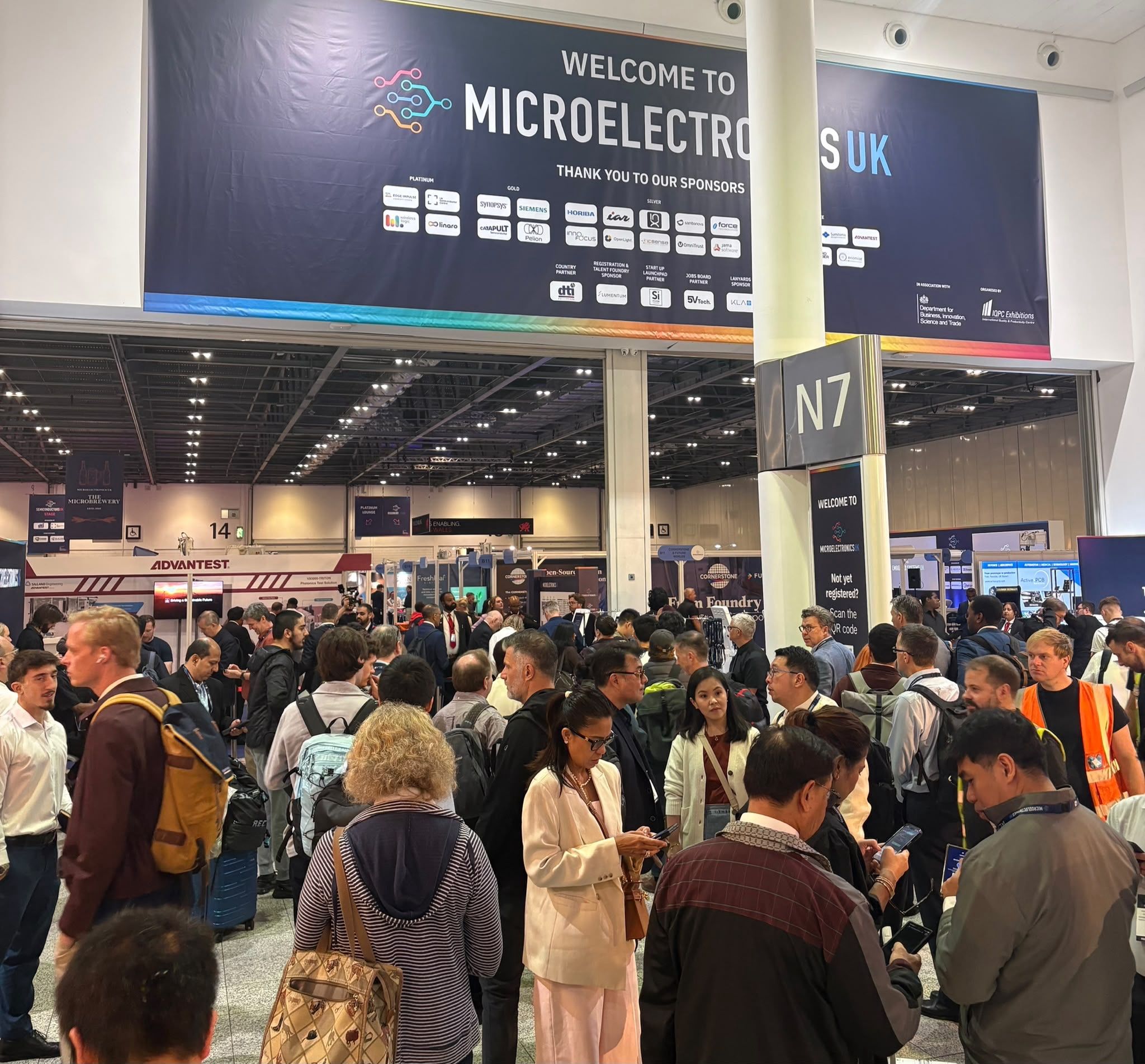
Microelectronics UK editor James Bourne shares his highlights of the opening day across the main content stages.
Day one of Microelectronics UK 2026 saw thousands of attendees enjoy a varied selection of content across semiconductors, photonics and embedded systems – and in some cases, a convergence of the three.
Julia Sutcliffe, Chief Scientific Adviser in the Department for Business Innovation, Science and Trade (BIST), opened this year’s show by emphasising the need for attendees to make connections, challenge assumptions, and identify barriers to success.
"As Chief Scientific Adviser at the Department for Business, Innovation, Science and Trade, I see every day how the UK's scientific strengths support growth, resilience, and national capability - and microelectronics sits at the absolute heart of that agenda," said Sutcliffe.
Sutcliffe noted that last year’s opening speaker, Kanishka Narayan, now becoming Minister for Artificial Intelligence, underlined the importance of this agenda across government, and that the minister has passed on his ‘very strong support’.
"I think it's clear that when companies, when universities, when investors, and when specialist facilities are co-located and can collaborate, ideas accelerate, supply chains become stronger, and businesses are much more likely to grow where they started," Sutcliffe continued. "Building those clusters of scale is not just about supporting one sector. It's about backing regional growth, creating opportunity right the way across the UK, and making sure that the technologies of the future drive growth in every postcode, as per the Prime Minister's commitment.
“What is government doing to help make that journey easier?” Sutcliffe asked. “That transition from technology and innovation into tradable outcomes; that's going to mean backing research. It's going to mean improving access to infrastructure, helping companies move from prototype to product, supporting skills and investment that will allow hardware businesses to grow."
Following this on the Semiconductor UK stage Rupert Baines, chair of the UKTIN Semiconductor Expert Working Group, and Prerana Joshi, research fellow at the Royal United Services Institute, explored the EU Chips Act 2.0 – but it was only a starting point for a wider discussion around geopolitics, supply chains, and sovereignty.
Where does the UK have the upper hand over the rest of Europe? “One of the starting points we have is building the startups,” said Baines adding that, the Baltics aside, the UK was ‘probably several years ahead of most of continental Europe.’ Yet there was a caveat. “In the UK, we’ve got a very good ecosystem now: academics, lawyers, VC funds, serial entrepreneurs, for doing deep tech startups, semiconductor startups.
“It’s a very good environment, but that takes you from pre-seed, to seed, to maybe A round, and that is when the wheels fall off – and the same is true across Europe.”
Could incentivising private capital to invest in hardware startups and to commit to that help, asked Joshi? “I think we’re getting there,” replied Baines. “This is an area I feel, if we were speaking 10 years ago, I would be very, very pessimistic. Semiconductors [were] out of fashion. VC didn’t like hardware. The ecosystem was really hurting, but we are seeing very good, positive policy changes in the UK.”
Baines cited Pragmatic Semiconductor utilising M&G as an example of how pension funds can take big positions. “We have very, very rich pension funds in Europe, and hopefully that will start to flow through the growth rounds, the B round, C round funds, that will enable that next generation of world-class companies.”
“I think there’s a few things that the UK could be doing more of,” said Joshi. “I think we’re getting very good at the culture of startups and tech bros and VC hubs. That’s naturally bleeding through from Silicon Valley, Cambridge Belt. I think from a diplomatic leverage perspective and from an economic leverage perspective, we’re good.
“We maintain our ability to influence to a degree on the world stage, but that middle gap between just doing business, having a culture of commerce, a culture of salesmanship, business translation – ensuring there’s a degree of translation between the technical procurement arms into the consumers – I think that’s something that has been missing.”
Over on the Photonics UK stage, space formed a key part of the morning’s discussions. With the UK’s National Space Strategy published earlier this month, it was the perfect timing. Robert Atchison, UK managing director at Clearspace UK, explored free space optical communications – and modular design.
“Where I now would ask, as we evolve as a community in terms of photonics, but also semiconductors, is that modularity is taken into account,” said Atchison. “I appreciate we are not talking yet about advanced robotics being able to go to certain subsystem level in an augmented way. I believe hopefully that will happen in the not-too-distant future.
“What I am talking about is the payload itself: is there a specific part of the system that can be modularised so it can be, quite literally, taken out of the spacecraft and then a new updated one put into a spacecraft?” Atchison added. “I am oversimplifying a very complex scenario, but it’s the concept, and for myself as an operator and spacecraft designer, those are things that are super-important.
“I have the privilege of working with people who make solutions to these problems, and also see things that I don’t – and so that’s where, as a community, I am also very keen to leverage that knowledge and those opportunities to pull it forward, because there might be a better way of doing things.”
On the theme of a better way of doing things, a panel on RISC-V and the future of open architectures made for an interesting session on the Embedded Systems UK stage. Andrew Moore, senior director of marketing at RISC-V International, who moderated the session, asked: what’s the most exciting thing about RISC-V?
“I think the key thing is the fact there are multiple companies innovating,” said John Ronco, SVP and GM at SiFive UK. “In the RISC-V world, you have multiple choices, or you can build it yourself. And that’s really the fundamental about the business model – you’re never locked in and you’re always going to have different possibilities for what you want to do.”
“There is a very healthy, I call it, co-opetition out there, that really drives innovation and helps customers to get the tailored solution they’re looking for, while at the same time also really leveraging the community out there,” added Markus Willems, director product management, processor IP and software development tools at MIPS, by GF. “The community is growing rapidly.
“I’ve been in this industry for 25 years now,” said Willems. “Observing the community grow in the last five years has been mind-blowing, and that proves the momentum that’s out there.”
“It’s differentiation, not fragmentation,” Ronco added.