)
)
The future microelectronics workforce: Pipelines and partnerships
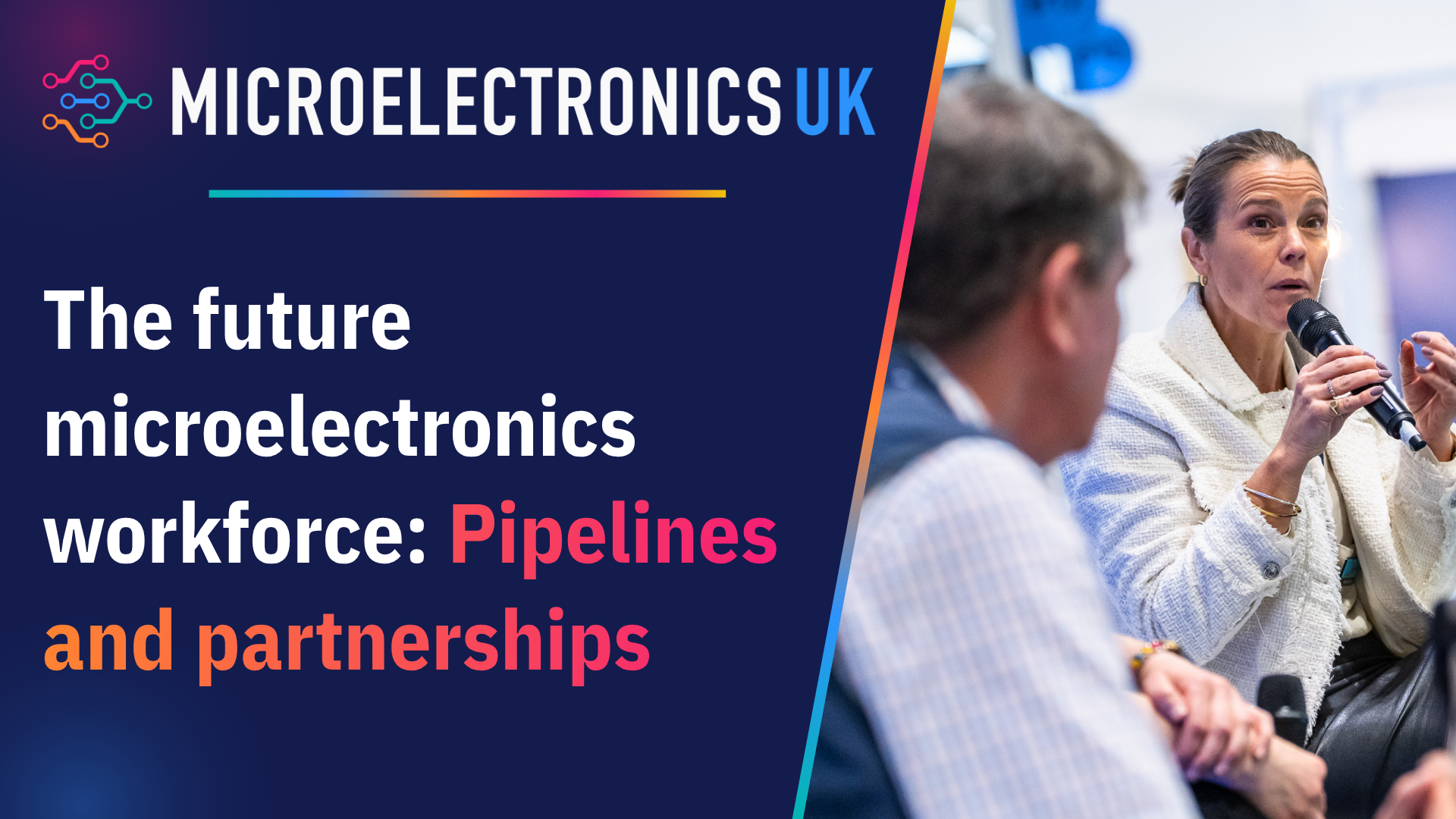
For the UK microelectronics industry to reach its potential, it needs to attract the best talent. With this in mind, the second morning on the Embedded Systems UK stage focused firmly on the future workforce.
The opening panel began by exploring where the industry should focus. Alexandra Leadley, director of skills and workforce at the UK Semiconductor Centre, emphasised the importance of raising the sector’s profile. “Semiconductor is not a word that is naturally discussed in the classrooms, especially at a young age, so when we, as a sector, then talk about jobs, why would they even know we exist?” said Leadley.
Recent government bursaries for students studying physics, materials science and computer science are welcome, but arguably only go so far. “Unless [students] see the industry and they have engagement with industry through their studies, the chances of us then benefiting from those students is quite low because they will just go into other industries,” Leadley added.
The session covered initiatives ranging from apprenticeships and graduate schemes to maintaining recruitment numbers and creating more early-career roles. Joanna Hart of Space Partnership, who moderated the session, noted the lack of early-career roles was a particular bugbear. The message to industry was clear: it must help attract the best STEM talent but also give them reasons to stay.
“These are bright young things, and they want to be challenged,” said Leadley. “They want to have things to work on, and I think if they’ve done a year in industry or had that early industry engagement, then they’re much more invested in the sector, the sector that supported them through their studies, funding or exposure, and we’re going to see much greater retention if we can get that industry engagement earlier on.”
One strength of the opening session was its mix of panellists: some with long industry careers, others experienced in finding and developing talent, and some relatively new to the sector. The latter included Shahin Mohammad Shahin, product engineer for electronics and complex systems at Jaguar Land Rover (JLR).
After graduating in electrical and electronic engineering (EEE) in 2022, Shahin shared his experience of the JLR graduate programme with the audience, noting many roles seemed to involve working alongside more experienced colleagues – and his desire to reach the same level. “I really think you should open these sorts of paths,” he said. “Yes, maybe more experience is required, but at the same time, people who don’t have as much experience may be willing to learn at a quicker pace.”
“I feel like it’s very important to take on people who are willing to learn, who can take on knowledge when they work,” Shahin added. “A lot of the skill set I have now, I’ve learned on the job at JLR.”
In the following session, which focused on inspiring early careers in electronics through educational partnerships, Krishnapriya CR (KP), senior director of engineering at Arm, expressed a similar view of graduate schemes. “We’ve been hiring graduates in my role and my team for years… and one of the main things we look for is not how much they know as such, but what attitudes they have,” said KP. “We check, what is their thought process? Are they asking the right questions? Are they thinking, even in fact radically different?
“Even if they’re going off a tangent and thinking radically different, that’s also great. You want free thinkers as well.”
Independent thinking also means taking the initiative and developing soft skills. Talk to people; ask for help when you need it; and build confidence in presenting your work. The UK Electronics Skills Foundation (UKESF) runs the government-funded Semiconductor Talent Award, offering 400 prizes, 300 of them for students on EEE degrees or closely related courses. Some of the recipients were in attendance at Microelectronics UK. “Part of what we’re trying to do is to complement their studies by developing this awareness and this confidence for them to speak,” said Stewart Edmondson, UKESF CEO.
Arm’s early-careers programme gives interns and graduates the chance to work on real projects. In KP’s hardware development team, project cycles are long, so creating meaningful work for a three-month placement takes conscious effort. “We try to break things down and say, ‘okay, there is a niche problem that can be solved’,” she said. “It could be research. It could be something that’s really impactful for the current team.
“We know that when graduates come into the company, they don’t come in with an idea that ‘hey, I’m going to be a designer or I’m going to be a verification engineer, software is my thing’,” added KP. “They come in fresh from university, saying [they’re] open to everything, and we don’t want to impede that at that point. We’d rather give them the opportunity to explore and to try to work with different teams.”