)
)
The future looks bright: Assessing opportunities for UK semiconductors and photonics
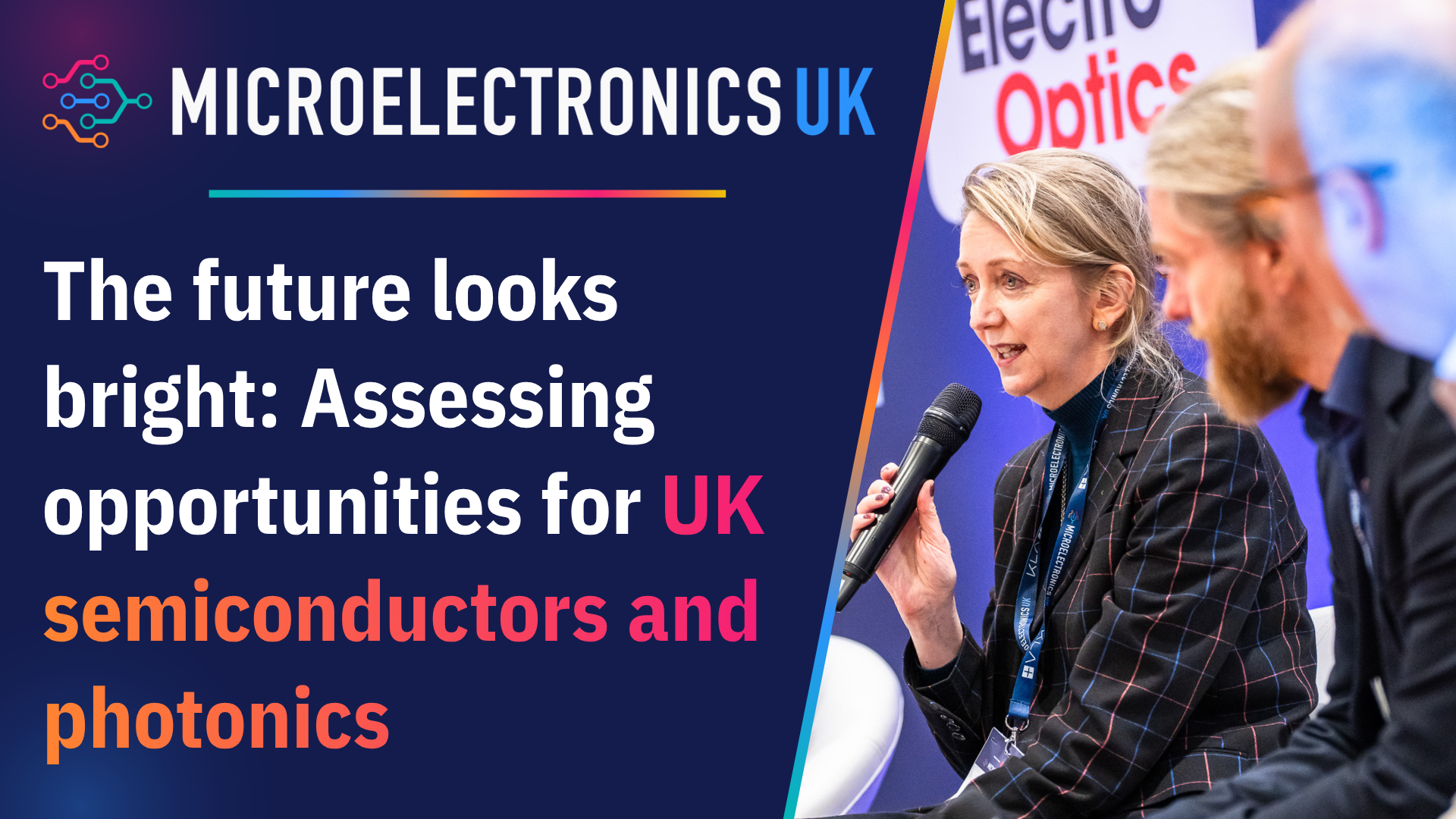
Two key panel sessions on the first morning of Microelectronics UK 2026 explored the UK markets for semiconductors and photonics, and the opportunities which lay ahead.
Julia Sutcliffe, chief scientific advisor at the Department for Business, Innovation, Science and Trade (BIST), opened the event with a clear call to action. “The UK has a really strong base on which we can build,” said Sutcliffe. “We’ve already got real depth in chip design, compound semiconductors, photonics, power electronics, and advanced materials. That is an amazing base. We also have excellent universities, four of the top 10 globally.
“We’ve got specialist facilities, and fundamentally, we’ve got ambitious companies that bring people together, that innovate, and that connect our shared strengths,” added Sutcliffe. “The task now is to make those strengths and those connections even easier to build, make systems easier to use, so we can turn those fantastic innovations into growth.”
Turning the UK’s potential into globally competitive businesses requires government, industry and academia to work together and move in the right direction. That was the aim of the ‘Exploring Opportunities in the UK Semiconductor Industry’ panel, bringing speakers together across all three areas.
The government has several aligned initiatives. Published in June, the AI Hardware Plan sits alongside the Modern Industrial Strategy and Digital and Technologies Sector Plan, with a focus on developing and scaling the chips and semiconductor technologies that underpin AI. Chris Bush, deputy director for semiconductors at BIST, noted the government’s ambition to create the UK’s first $1 trillion company – “no pressure for anybody in the room today”, he joked – before discussing what sovereign capability means for the UK today.
“I think the first thing to say is what it isn’t, which is becoming self-sufficient,” Bush told delegates. “That’s clearly not realistic. I think it’s hard for any country to be completely self-sufficient when it comes to the end-to-end semiconductor supply chain.
“I think it is about recognising our strengths, doubling down on those, putting investment particularly into areas like skills [and] innovation, and it’s about making sure we are able to support our existing companies like Arm, but also make sure we’re growing the next generation of companies which is going to have critical parts in that future supply chain.”
Partnerships are therefore key. What does effective collaboration look like? Peter Stephens, director of government partnerships UK at Arm, posed a central question: how can UK innovation serve a global ecosystem?
“I think there are niche applications where there is also a greater degree of need for it to be, as much as it can be, UK-focused, but I think proportionately, the biggest challenge here is how do we make sure that these companies can engage… their innovation with global ecosystems, and what role can government do to help remove those barriers?” said Stephens.
Evelyn Toma, director of strategy at the James Watt Nanofabrication Centre, represents academic R&D and, through partner Kelvin Nanotechnology (KNT), a route to commercialisation. “The way I would think about it is, what do effective collaborations give you?” asked Toma. “They have to give you a line of sight to revenue generation for the companies involved or they won’t have skin in the game.”
The path is far from easy. One CTO told Toma that moving from an initial working prototype to a product qualified by a customer and capable of making money took almost 10 times as much effort.
Toma cited Sivers Semiconductors, which provides photonics for AI processing in data centres, as an example. The company used KNT for its first commercial steps, then reinvested revenue in reliability, yield enhancement and integration. Last month, it secured $30 million in funding to produce 100 million lasers by the end of 2027. “I think it’s a really good example to bring to life the difference that collaboration with the research base can make when it’s… focused around delivery and manufacturability,” Toma added.
From a broader photonics perspective, the long-awaited UK Photonics Roadmap could raise awareness and improve alignment across the sector. The opening Photonics UK panel explored its potential impact. Lewis Hill, general manager at the Photonics Leadership Group (PLG), said that, following a recent PLG visit to Parliament, the roadmap would hopefully be ready ‘within the next couple of months’.
The panel considered two key questions: why is a roadmap needed now, and what will it solve? Iain Mauchline, head of semiconductors at Innovate UK, noted that photonics ‘sits across all of the deep tech areas’. The roadmap, he said, needs to identify strengths and gaps, and bring a diverse, somewhat disparate community together.
Raj Gawera, COO at the UK Semiconductor Centre, said the roadmap should be a ‘game plan’ for UK success, backed by a commitment to move quickly and decisively.
“What that means is, if we’re going to invest, let’s not debate it for six or 12 months before we actually invest,” said Gawera. “Let’s invest early on when we’ve got a chance of keeping up with the competing nations.
“This space is moving very fast. No-one’s waiting for us to jump on the train. We’ve really got to grasp it for ourselves.”
Partnerships also featured in discussion of how to ensure SMEs are heard. Gawera described the UK Semiconductor Centre’s role as helping to ‘make serendipity more frequent and happen more’. But that requires a framework, and one of the centre’s goals is to map the UK ecosystem.
“We’re starting with the semiconductor ecosystem because that’s our home turf, but as we know, semiconductor links to everything else, so pretty soon we’re getting it sucked into photonics, into quantum, into AI hardware, because everything touches everything when it comes to semiconductors, which makes it even more important to map out that ecosystem and see what it looks like,” said Gawera.
Innovate UK, meanwhile, is working with the UK Semiconductor Centre on a Global Innovation Network (GIN), which aims to become a trusted gateway linking the UK semiconductor community with overseas companies, research institutes and government partners. “A lot of times, you don’t know what’s happening one street away from you,” said Mauchline. “The UK is not a big place. We should know each other, but we don’t. So, we’re trying to knit it together in various ways.”
Getting the underlying infrastructure right may be the most important step – and it is closely linked to the skills challenge. As Toma put it, investing in infrastructure means investing in the wider startup and SME community.
Stephens also stressed the need for long-term infrastructure investment, considering where the UK should position itself not just in five years, but in 15. “It’s this challenge of we’ve got a lot of great people who are, for whatever reason, feeling this isn’t a sector for them, and are leaving to go elsewhere within the UK,” said Stephens.
“For the UK’s competitiveness, more broadly, the greatest asset we have, in a world where energy is expensive and infrastructure is tough to invest in, is people. How do we make sure we’re doing more to make sure that we’re having that sort of talent coming through, but also retaining the talent we’ve got in the UK as well?
“Skills investment does take 10, 15 years to materialise and to recognise that you’ve done it.”
“An investment in infrastructure is not a one-off bet,” added Toma. “It’s an investment in a whole community of people that need to use that infrastructure.”